On attempts to transcend Qualia
Excerpts from a narrowly diverted quarter life crisis.
Come up the spiral with me
What makes a photo aesthetic to me? was a question I was recently ruminating on.
In some sense, verifying beauty is P. Hand me a photo and I can immediately tell if it’s good or bad (to me). The arrangement, the colors, the layers of meaning hidden pop in my head like wizards who just passed the apparition test. I understand that its subjective - but I just know.
In contrast, trying to construct what makes a photo beautiful from first principles is NP-hard. There are no rules - I see it as land with some well trodden routes, and some roads less taken. The search space is, simply put, intractable. Explaining why you like what you like - is even tougher. As a first example: take a look at this photo - what do you see?
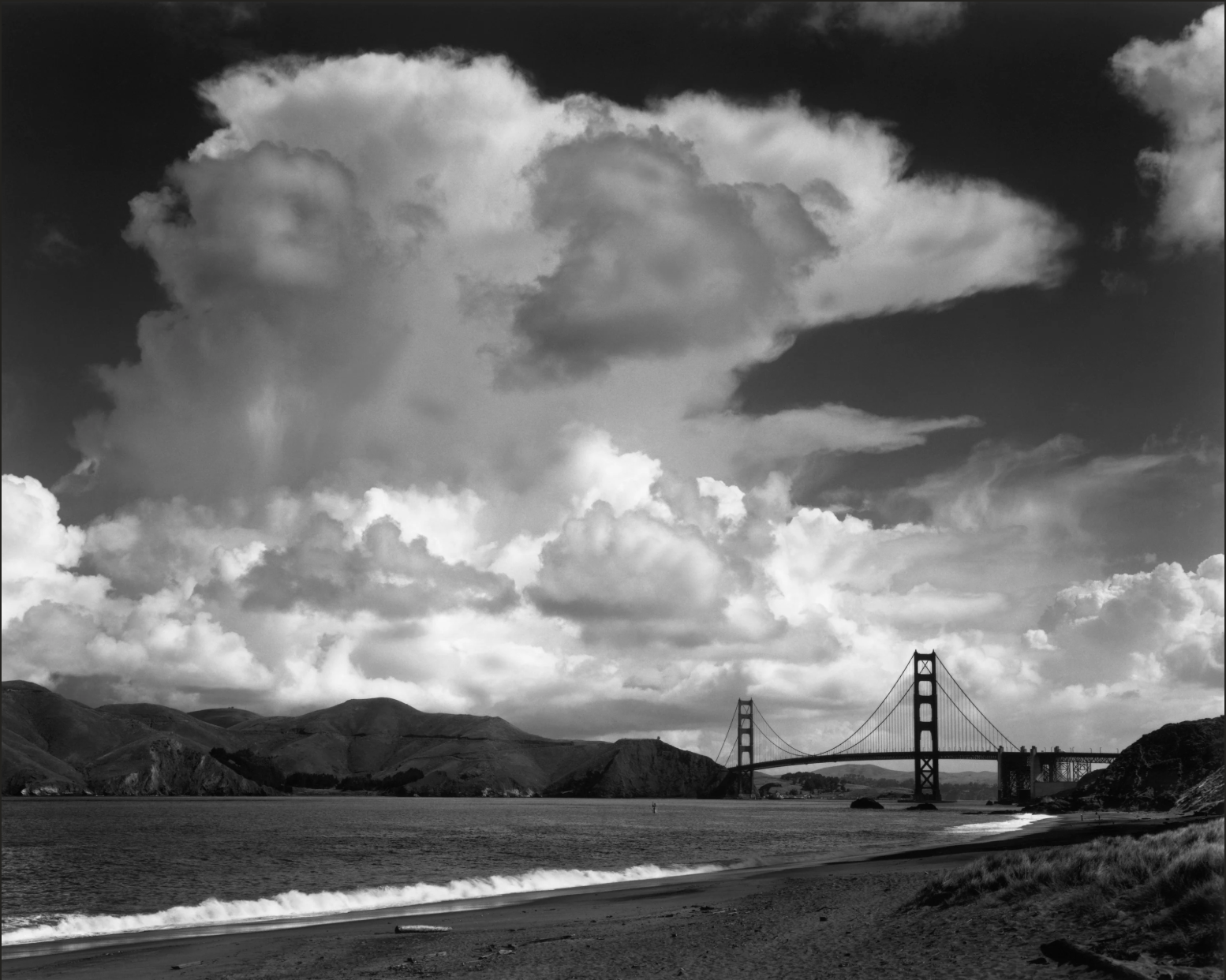
The Golden Gate Bridge from Baker Beach (Ansel Adams, 1952).
The cumulus clouds engulf much of the frame; I can almost hear the waves crash against the shore - as they have been doing for millennia. How puny are we humans to feel self-important over a bridge? We all bow down to nature eventually. Ansel hints at this by shoving the bridge at the corner of the frame. Always smaller than the coastlines, always shorter than the sky, always younger than the sprawling hills that surround it. One must hypothesize that he felt ephemeral, a temporary fiber in the fabric of time and space. Holding deep reverence for these headlands, he fought against construction of high rises in what is known as the Golden Gate National Recreational Area today.
The added context makes the difference between a postcard-pretty shot and a piece of environmental activism. This naturally extends to other things in life too. Here’s a more concrete grounded example: When you tell someone - The clouds are beautiful today. What I mean is something different - it’s that:
- Most winter days are cloudless, so it’s rare that we have clouds.
- I’ve been looking at skies everyday for the last 2 months & today’s sky is the 5th best of all of them.
- I’m already thinking about how good these clouds will look during the golden hour.
This turns a simple statement into a full blown topic of its own. Even then, people interpret what you say in their own way. They reply Ooh! That’s shaped like a mouse!. If the complexity gets blown out of hand for such a simple statement about weather - imagine trying to tell someone how you view money. About how you want to be loved. About how a tragic loss reshaped you. To ponder over the consequences feel like slowly sinking into a quicksand.
It will, of course, make us dizzy; for all points that our eyes used to rest on are taken away from us, there is no longer anything near us, and everything far away is infinitely far.
– Rainer Maria Rilke, Letters to a Young Poet.
A problem statement
Succinctly put, you are alone. In the most visceral, depressing, caged sense of the word. Your experiences, your upbringing, how you perceive the world are unique to you. This should make you pay more attention to your senses, how you process reality. The loneliness creeps in the certainty that another human being can never understand you - how deeply your fears petrify you, or how your hopes enrich you.
Language is fatally, a lossy compressor.
Trying to bury the skeletons in the closet of our own minds doesn’t work here - a constant background chatter appears when we talk to others: Why do you even express yourself when people won’t understand?. Slowly, you summarize your thoughts to optimize for high-fidelity communication. You hide the messiness; You don’t want the noise to obscure the signal. You carry the weight of your isolation like it is the sky.
While being a useful, rational chain-of-thought experiment - this is a net negative for our mental health. In my experience, the isolation curdles. You feel sad. The sadness turns into bitterness, and bitterness turns into anger. Research too suggests that humans are wired to be social animals.
Some closed form solutions
In the spirit of existentialism - let us go through the problem than around it; lead a more intentional life with a full understanding of its complexity. Surely, crippling loneliness can’t be the only solution?
I personally found partial solace in the following.
On giving, receiving & processing advice
..many things must happen, many things must go right, a whole constellation of events must be fulfilled, for one human being to successfully advise or help another.
– Rainer Maria Rilke, Letters to a Young Poet.
This is the Occam’s razor of why self-help books start feeling preachy after a point - it might be something that the author has realised deeply, but when rubber meets the road, it just comes off as a TODO list with anecdotes and BibTeX citations. As a receiver, be wary of the lossy compression - take all advice with a grain of salt (cough, cough, Irony).
Perhaps, the best we can do when someone comes looking for advice, is to draw from personal experience. Include enough context, and empower them to choose on their own. Concretely, instead of saying: Do X, say: I was in a similar situation when X happened, I chose Y because Z. Advice shouldn’t dictate, but inform. Unsolicited advice is often received poorly - because the receiver decompresses your statements into garbage.
In the same vein, lessons in life often come from lived experiences. They cannot be inherited like theorems; they accumulate like layers of fertile silt on soil, slowly and over time, on which values and beliefs sprout and flourish. Prioritize novel experiences that expand your horizons, retrospect and incorporate learnings from them.
On agency, and existentialism
We can try to see our uniqueness/isolation as a feature, not as a bug. When no single person can excavate your deepest thoughts - it issues a call to pick up the shovels and dig. Dig, because you stand to gain profound clarity over decisions in life which have no right answer, where everyone is hopelessly stranded. You stand to ground your life in your values, your beliefs, that calcify over time. This is not selfish or narcissistic - you can still value the well-being of your loved ones, the comfort of your home. The point is that you choose what to value, with full ownership of that choice.
It permits you to be authentic, to discard a few costumes that we put-up for society. In an already fragile ecosystem, why add more layers of indirection? Unless we get digital bodies, people probably will not remember you in two centuries’ time. Perhaps we should rant about the clouds anyway.
On living the questions
I would like to beg you dear Sir, as well as I can, to have patience with everything unresolved in your heart and to try to love the questions themselves as if they were locked rooms or books written in a very foreign language … And the point is to live everything. Live the questions now. Perhaps then, someday far in the future, you will gradually, without even noticing it, live your way into the answer."
– Rainer Maria Rilke, Letters to a Young Poet.
Qualia cannot be transcended - perhaps it shouldn’t be; for it gives humanity texture. Maybe it is an asymptote that cannot be reached.
To remind ourselves, we’re here not because we ache to be understood, but because we don’t want to feel alone. Thankfully, this is a solvable, albeit still a tough problem. It calls for intent listening - someone who is willing to sit with you and say - “I don’t understand what you’re going through, but I’m here to witness & accompany you while you grow & process this”. You need patience, not omniscience.
Our thoughts and insights sit in our head, just out of reach, like a web waiting to be unraveled. To do so - we must persist them tangibly, on a medium. It doesn’t need to be public. It could be a journal, it could be a blog much like this one, a painting, music, poetry; art. Do so for your own sake, and selfishly. In the worst case, you get to understand yourself better. In the best case, your work acts like a lighthouse, pulling like-minded people in your direction. It exists, not to seek for validation; but as potential energy, capable of magnifying and attracting.
Now that the minimum viable solution is uncovered, we must extend this privilege to everyone we meet. The world is a sad place, and maybe everyone’s feeling just the way you are. We must try approaching every conversation with the intent of How can I make the other person less lonely?. Its surprisingly stoic, and invites them to mirror your behavior.
Maybe the best that we can do, is to make our $\epsilon$-radii neighborhood more livable.
An epilogue
I found Rilke’s Letters to a young poet much after I’d written this. Reading it made me feel seen - as if someone else had worked through the same questions, and arrived at the same answers - reaching me after a century. Apparently the lighthouse works.